
Adams County operates more than one public-safety service that must function around the clock.
But their overtime costs are moving in very different directions.
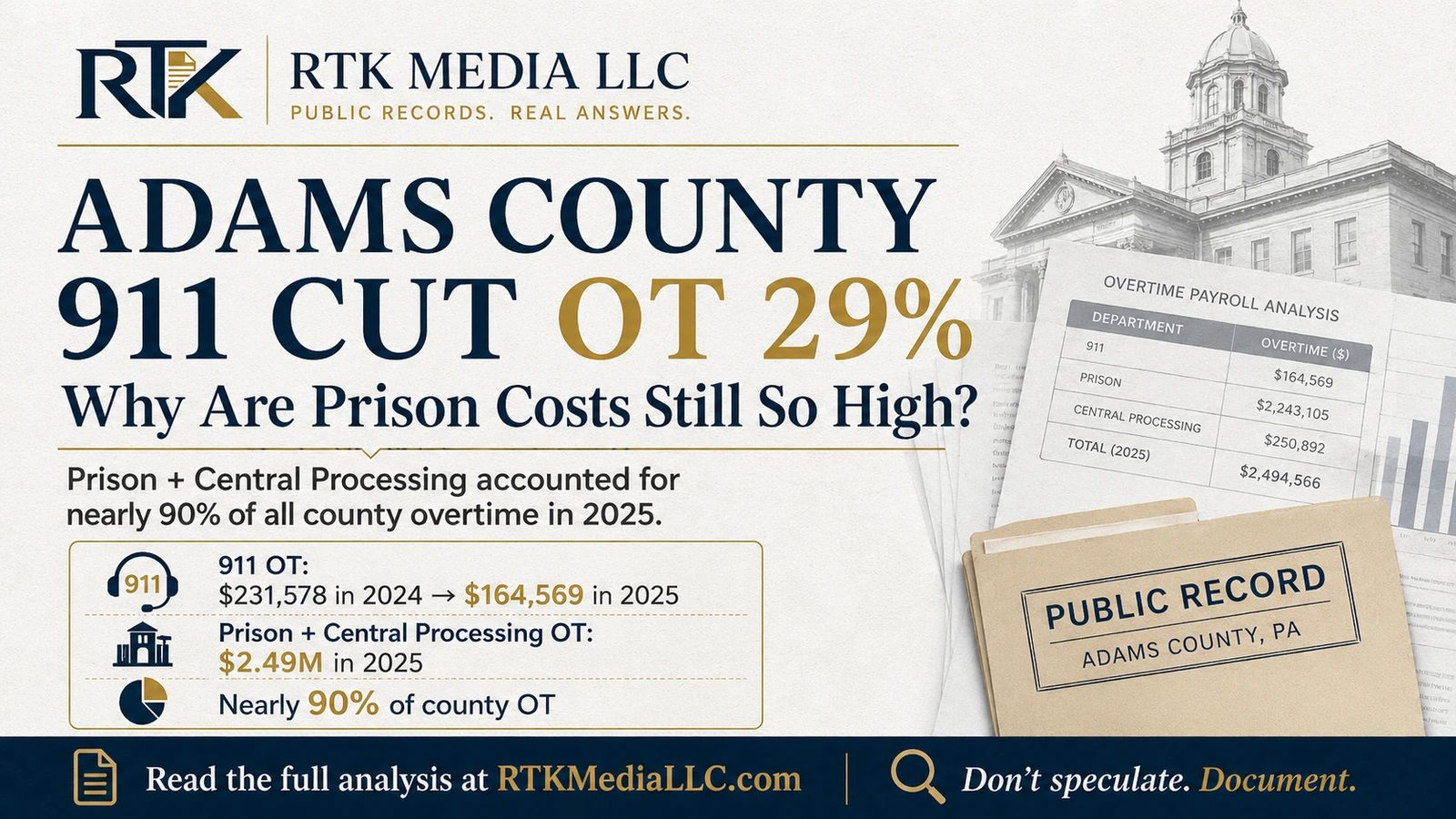
Payroll records reviewed by RTK Media show that Adams County 911 paid approximately $231,578 in overtime in 2024.
In 2025, that figure fell to approximately $164,569.
That represents a reduction of about 29% in one year.
Estimated overtime as a percentage of underlying base earnings also declined, falling from roughly 20% in 2024 to about 14% in 2025.
The change stands in sharp contrast to overtime spending elsewhere in county government.
In 2025, the Adams County Prison and Central Processing combined for approximately $2.49 million in overtime, accounting for nearly 90% of all overtime paid by the county.
That does not mean the operations are directly comparable in every respect.
But the comparison matters.
Both must operate 24 hours a day.
Both depend on trained employees.
Both require minimum staffing levels.
And both operate within the same county and regional labor market.
Yet one operation substantially reduced its overtime while the other continues to rely heavily on it.
The 24/7 explanation only goes so far
One of the most obvious explanations for high prison overtime is that incarceration is a continuous operation.
Someone has to be there.
Posts must be staffed. Inmates must be supervised. Medical, security and intake functions cannot simply close at the end of a normal workday.
But Adams County 911 faces a similar basic reality.
Emergency calls do not stop overnight, on weekends or on holidays.
Dispatchers and emergency communications personnel must remain available regardless of staffing challenges, vacations, illnesses or vacancies.
The fact that 911 reduced overtime by nearly one-third in a single year does not prove that the prison should be able to do the same.
It does, however, show that operating around the clock does not automatically require rising or extraordinary overtime costs.
That shifts the question from whether overtime is necessary to why so much of it is necessary in some departments.
Prison-related overtime dominates county totals
The broader payroll picture makes that question difficult to ignore.
Adams County paid approximately $2.78 million in overtime in 2025.
About $2.49 million of that went to the Prison and Central Processing.
Previous analysis of the county payroll records found prison overtime equal to roughly 70% of regular payroll, while Central Processing overtime was approximately 216% of regular wages.
By comparison, most other county departments had overtime levels below 5%.
The pattern was not limited to a single unusual pay period or short-term staffing emergency.
Heavy overtime was also evident in the prior year.
That raises a much larger operational question:
Has overtime become a temporary solution to staffing shortages, or has it effectively become part of the normal staffing model?
The missing piece is staffing
Payroll data can show how much money was spent.
It cannot, by itself, explain why.
There are several possible explanations.
The prison may have more vacancies than 911.
Corrections positions may be harder to recruit for or retain.
Turnover may be significantly higher.
Collective bargaining agreements, minimum staffing rules or scheduling requirements may limit management’s options.
It is also possible that county officials have determined that paying overtime is cheaper than hiring enough additional employees to eliminate it.
Those possibilities should not be assumed.
They should be documented.
That is why the next phase of RTK Media’s review will focus on staffing records, including:
- authorized positions;
- filled and vacant positions;
- employee turnover;
- hires and separations;
- vacancy duration;
- recruiting activity; and
- retention trends.
Those records should help answer whether the extraordinary overtime levels are primarily the result of vacancies, turnover, scheduling practices, budget decisions or something else.
A second transparency question
The payroll records also revealed another difference between the county’s public-safety operations.
The county disclosed the names of 911 employees in the payroll data reviewed by RTK Media.
Most employee names associated with the Prison and Central Processing were withheld.
That creates a separate public-records question.
If taxpayers are permitted to see which public employees received overtime compensation in one public-safety operation, why are similar names withheld in another?
The issue is particularly significant when millions of dollars in public payroll spending are involved.
RTK Media intends to continue reviewing both the underlying staffing issues and the county’s handling of payroll transparency.
For now, the numbers establish one important point:
Being a 24-hour government operation does not, by itself, explain extraordinary overtime.
Adams County 911 proved that its overtime could move sharply in the opposite direction.
The next question is why.
Don’t speculate. Document.