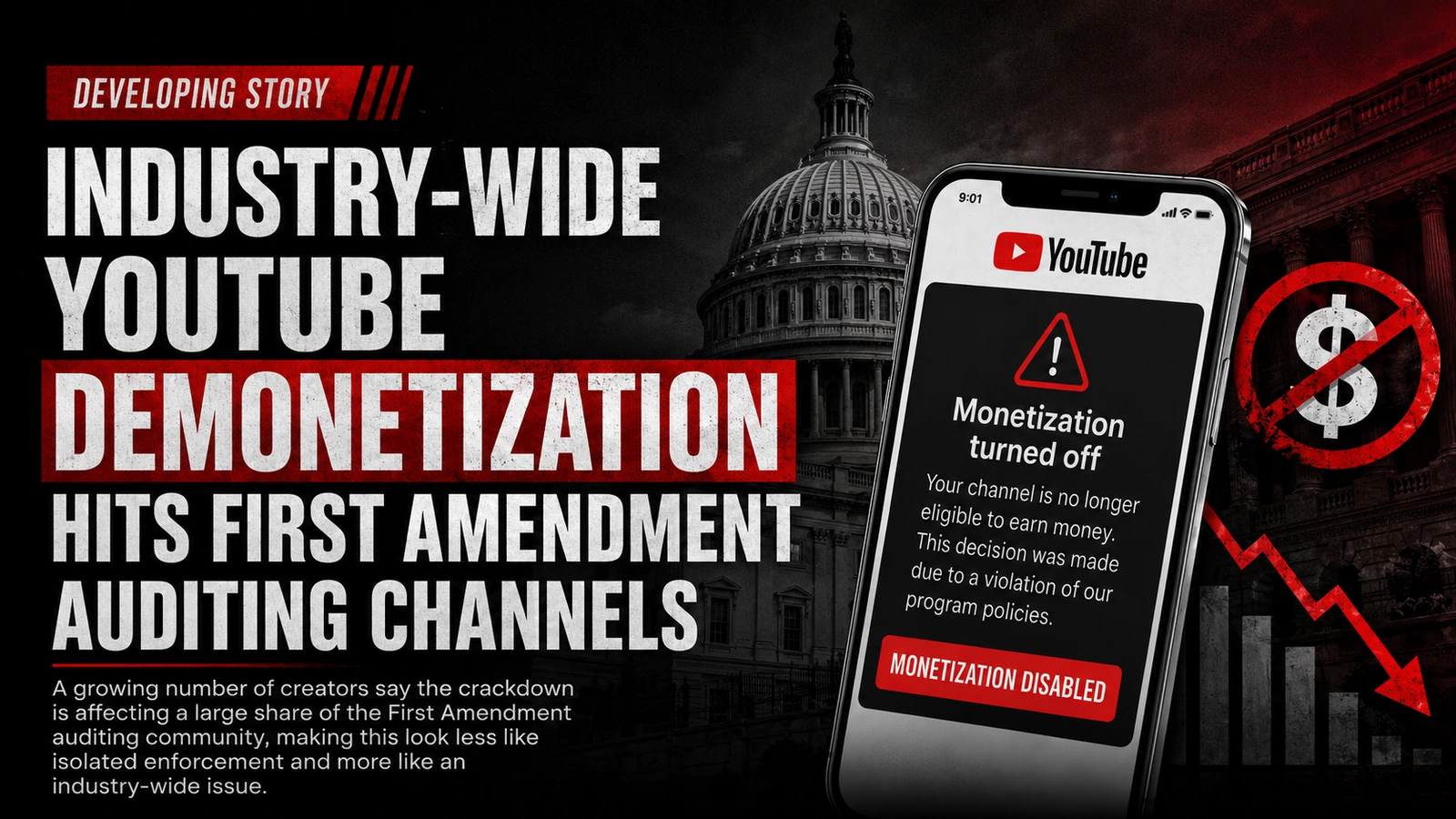
Multiple government accountability creators say YouTube removed their monetization at roughly the same time, raising new questions about how the platform is treating channels whose content centers on police, public officials, government agencies and public buildings.
RTK Media has now documented at least six First Amendment auditing channels that say they were affected: Bay Area Transparency, Odd Man Audits, Liberty Troll, Chunky Cholo Audit, Press NH Now and Long Island Audit.
Long Island Audit alone has more than one million subscribers.
What makes the situation notable is that creators are not describing isolated ad restrictions on a single controversial upload.
They are describing channel-level monetization actions that appear to have occurred in the same general time frame.
The pattern looks broader than one creator dispute
Bay Area Transparency says YouTube removed monetization under its Creator Responsibility Policy.
According to the creator, the demonetization lasts 90 days, after which the channel must reapply. He also says YouTube did not identify a specific video or incident that triggered the action.
Odd Man Audits received a separate notice stating that a team of policy specialists reviewed the channel and determined that some of its content did not comply with YouTube Partner Program policies.
Other creators soon reported similar outcomes.
Taken together, those notices make this look less like one creator losing revenue on a controversial video and more like a broader review of an entire category of content.
That does not establish wrongdoing by YouTube.
It does establish that the trigger for the review is now a legitimate public-interest question.
Why these channels matter
First Amendment auditing channels occupy a unique corner of the YouTube ecosystem.
Their content often involves filming police officers, public employees, courthouses, public buildings and government officials while testing the boundaries of public access and constitutional protections.
Some creators have been arrested, cited, prosecuted or drawn into lawsuits directly connected to that work.
That does not exempt them from YouTube's private platform rules.
But it does make one question especially important:
If a large number of channels focused on government accountability were reviewed at nearly the same time, what caused that review to happen?
The FTC was already asking similar questions
The government angle becomes more interesting because the Federal Trade Commission had already begun examining this type of platform conduct.
In February 2025, the FTC opened an inquiry into technology-platform censorship and specifically identified demonetization as one of the practices it wanted to examine.
The agency raised concerns about opaque enforcement systems, unclear explanations for users and limited appeal processes.
One question in that FTC inquiry stands out now.
The agency specifically asked whether adverse platform actions were made in response to the actions of state, local or federal governments.
It also asked whether advertiser pressure, outside organizations or coordination with third parties played a role.
That is almost exactly the set of questions being raised by this developing wave of First Amendment auditor demonetizations.
There is no evidence yet that government agencies caused the demonetizations
At this point, RTK Media has no evidence that any federal, state or local government agency ordered, requested or caused YouTube to demonetize these channels.
That distinction matters.
The existence of simultaneous demonetizations, by itself, does not prove outside influence.
There are several possible explanations.
This could have been an internal YouTube policy sweep.
It could have been advertiser pressure.
It could have been coordinated complaints from users or outside groups.
It could have involved referrals or communications from government agencies.
Right now, those are possibilities, not conclusions.
The timing raises the stakes
The timing gives the story added significance.
On August 27, Reuters reported that the FTC had been investigating YouTube over whether the company may have misled users about its content policies and how those policies are actually enforced.
According to that report, FTC attorneys were in the final stages of preparing a potential consumer-protection lawsuit against YouTube, although no lawsuit had yet been filed and YouTube had not been accused of wrongdoing.
Within days, First Amendment auditing creators began publicly reporting channel-wide demonetization actions.
That sequence does not prove a connection.
But it does make transparency from YouTube more important, not less.
What RTK Media is looking at next
RTK Media is continuing to document affected channels, review the notices they received and examine the timeline surrounding the demonetizations.
Among the questions that remain open:
- How many auditing channels were actually affected?
- Were they reviewed by the same team or under the same policy theory?
- Did YouTube identify specific videos or only cite broader channel-level concerns?
- Were complaints submitted shortly before the demonetizations?
- Did advertiser pressure, outside organizations or coordinated complaints play a role?
- Did any government agencies submit complaints, referrals or communications before the reviews?
The story matters because these creators are not lifestyle influencers or entertainment channels.
Their work is often adversarial to government power.
When channels built around filming police and public agencies are suddenly demonetized in clusters, the public deserves to know what happened.
The answer should come from the records
The responsible way to approach this story is not to guess.
It is to document the pattern, compare the notices and determine what can actually be proven.
If this was simply an internal YouTube enforcement decision, records and consistent explanations should help show that.
If pressure from advertisers, outside organizations or government actors played a role, that would matter too.
For now, one point is clear.
This is no longer just an isolated creator complaint.
It appears to be a broader issue affecting a significant share of the First Amendment auditing space.
That makes it a story worth following.
Don't speculate. Document.
Editor's note: This article is based on creator statements, notices reviewed by RTK Media and public reporting referenced by those creators. Additional affected channels may emerge as more creators disclose actions taken against their monetization status.