
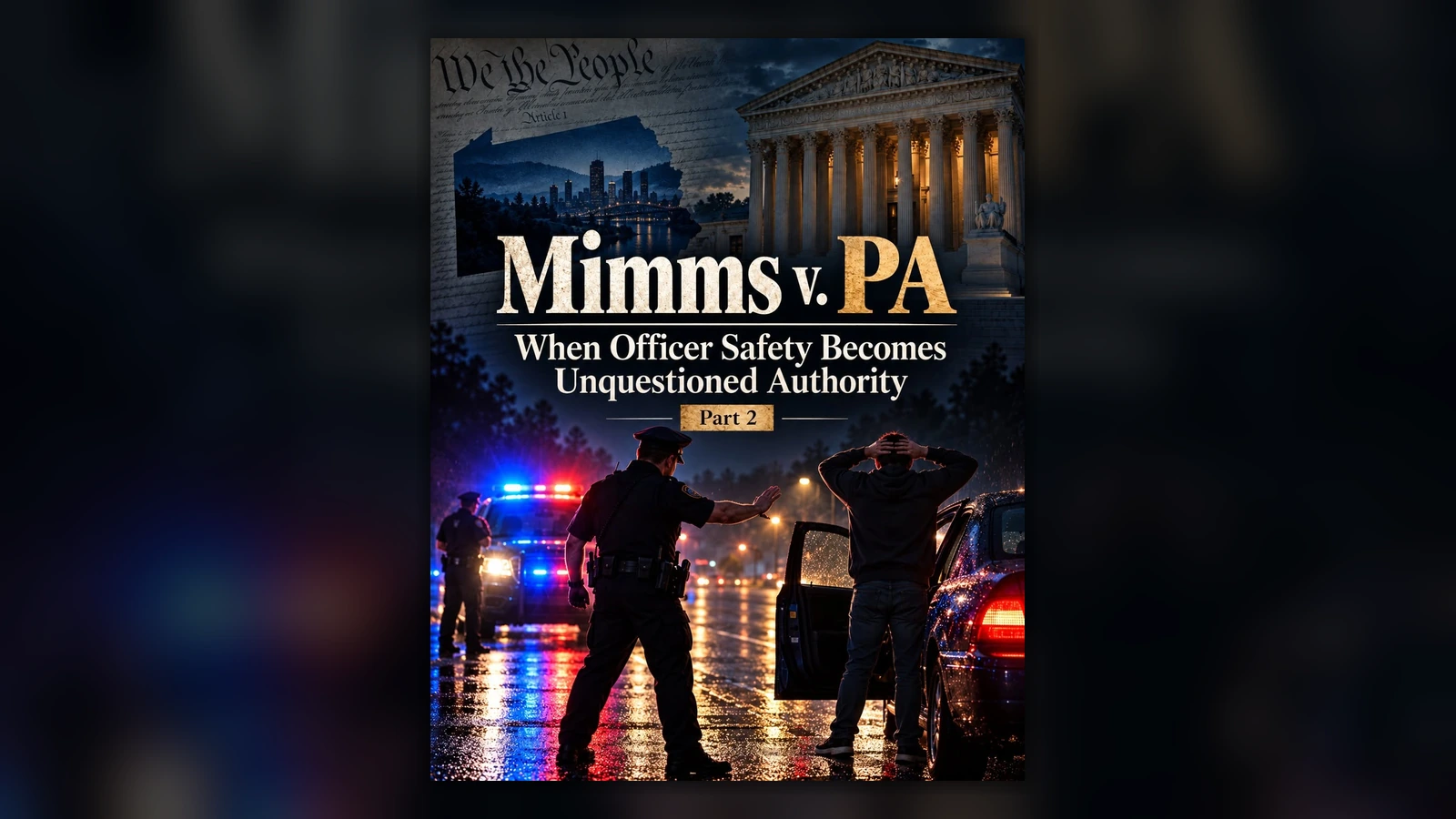
Imagine being stopped for a minor traffic violation.
You hand the officer your license.
You are sitting inside your vehicle.
You have made no threatening movement.
The officer has not told you that you are suspected of another crime.
No weapon is visible.
Then comes the command:
“Step out of the vehicle.”
You ask why.
The answer may simply be:
“Because I told you to.”
For many motorists, that exchange can feel like an extraordinary exercise of police authority.
Under current federal constitutional law, however, the officer generally does not have to establish that the driver is dangerous before issuing that command during a lawful traffic stop.
That is the legacy of Pennsylvania v. Mimms.
And nearly 50 years after the United States Supreme Court decided the case, that may be the most consequential part of the ruling.
The issue is no longer simply whether police should be able to remove someone from a vehicle when an officer reasonably fears for his or her safety.
Few people would dispute that police should be able to protect themselves when circumstances genuinely suggest danger.
The much harder question is this:
Should an officer have to articulate any reason at all?
Under Mimms, the answer is generally no.
From Officer Safety to Automatic Authority
As discussed in Part 1, Harry Mimms was stopped in Philadelphia in 1970 because his vehicle displayed an expired license plate.
The officer who ordered Mimms from the vehicle did not claim Mimms had behaved suspiciously.
There was no threatening movement.
There was no visible weapon before Mimms exited.
There was no specific indication of danger.
In fact, when the case reached the United States Supreme Court, Pennsylvania acknowledged that there had been nothing unusual or suspicious about Mimms’s behavior.
Ordering drivers from their vehicles was simply the officer’s routine practice.
The Supreme Court nevertheless upheld the practice.
The Court concluded that officer safety represented a substantial governmental interest while requiring an already-lawfully-detained driver to stand outside the vehicle imposed only a minimal additional intrusion.
That produced an extraordinarily broad rule:
Once a motor vehicle has been lawfully detained for a traffic violation, police may order the driver out of the vehicle without first establishing individualized suspicion that the driver is dangerous.
That distinction deserves more attention than it receives.
Mimms did not merely give an officer authority to act when something seemed wrong.
It removed the requirement that something seem wrong at all.
“Officer Safety” Without an Individualized Safety Concern
Police officers unquestionably face risks during traffic stops.
That fact was central to the Supreme Court’s reasoning in Mimms.
But the rule the Court created does something unusual.
The justification for the rule is officer safety.
Yet an individual officer generally does not have to demonstrate an individualized officer-safety concern before using it.
Think about that distinction.
An officer may approach a vehicle and immediately decide:
“Driver, step out.”
Or the officer may speak with the driver first.
The driver may question why he was stopped.
The driver may disagree with the officer.
The driver may be irritated.
The driver may refuse a request to search the vehicle.
The conversation may become uncomfortable.
Then the officer may say:
“Step out of the car.”
From the driver's perspective, the order may appear to have been triggered by the disagreement.
But under Mimms, the constitutional validity of the exit order generally does not depend upon the officer proving that the disagreement created a safety concern.
That is the problem created by a categorical rule.
It becomes extremely difficult to distinguish between:
an exit order genuinely motivated by safety
and
an exit order being used to establish control over someone who is questioning the officer.
The constitutional authority exists either way, provided the underlying traffic detention remains lawful.
The Power to Command
This is where Mimms becomes about something larger than standing beside a vehicle.
It becomes about control.
Traffic stops already involve an enormous imbalance of authority.
The motorist has been seized for Fourth Amendment purposes.
The officer controls when the driver leaves.
The officer controls much of the interaction while the traffic violation is being addressed.
And Mimms gives the officer another powerful tool:
the ability to change the physical setting of the encounter without having to establish that the particular motorist presents a danger.
Inside the vehicle, the driver is seated in a familiar environment.
Outside the vehicle, the dynamic changes.
The officer determines where the driver stands.
The officer can observe clothing and body movements that may not have been visible inside the vehicle.
Other officers may position themselves around the motorist.
Questions can continue away from passengers or cameras mounted inside the vehicle.
Additional observations may be made.
None of that means the officer automatically gains authority to search the person.
That distinction is important.
But the exit order can create the circumstances from which additional suspicion develops.
That is exactly what happened to Harry Mimms.
Police did not see the bulge beneath Mimms’s jacket until after they ordered him out.
The exit order revealed the observation.
The observation justified the frisk.
The frisk revealed the gun.
The gun resulted in prosecution.
The exit order sat directly in the middle of the chain.
Mimms Is Not a Free Pass to Search You
This distinction is critical.
Mimms gives police broad authority to order a driver from a lawfully stopped vehicle.
It does not automatically authorize police to frisk that driver.
It does not automatically authorize police to search the vehicle.
It does not automatically give police probable cause to arrest someone.
The Supreme Court has continued to recognize these separate constitutional requirements.
In Arizona v. Johnson, decided in 2009, the Court reiterated that officers conducting a traffic stop need reasonable suspicion that a person is armed and dangerous before conducting a protective pat-down.
That requirement applies even though the person has already been lawfully detained during the traffic stop.
So there is an important constitutional line:
GET OUT OF THE VEHICLE: Generally permitted during the lawful traffic stop without individualized suspicion of danger.
FRISK: Requires reasonable suspicion that the person is armed and dangerous.
SEARCH: Requires some additional lawful basis, such as consent, probable cause, a warrant, or another recognized exception.
That distinction is sometimes lost during roadside encounters.
And it creates another investigative question:
How often does the unrestricted exit order become the first step toward developing the justification for increasingly intrusive police actions?
Then the Supreme Court Expanded Mimms
Twenty years after Mimms, the Supreme Court went further.
In Maryland v. Wilson, decided in 1997, the Court considered whether police could also order passengers from a vehicle.
Passengers presented a more difficult constitutional issue.
Unlike the driver, a passenger ordinarily has not committed the traffic violation that caused the vehicle to be stopped.
The Court acknowledged that distinction.
It still extended the rule.
The Supreme Court held that police may order passengers out of the vehicle while the traffic stop is being completed.
Once again, officer safety outweighed what the Court considered a relatively minimal additional intrusion.
The result was significant.
Police no longer merely possessed categorical authority over the driver who allegedly committed the traffic violation.
They possessed it over the occupants of the vehicle as well.
And Justice Anthony Kennedy identified precisely what was troubling about that expansion.
In dissent, Kennedy emphasized the importance of “principled, accountable decisionmaking” and argued that when someone is subjected to an additional seizure, there should ordinarily be a satisfactory explanation for the officer’s decision.
Justice John Paul Stevens went even further.
He warned about what happens when broad police authority becomes routine.
The concern was not that every officer would abuse it.
The concern was that the Constitution no longer required an officer to explain why the power was exercised against this particular person.
“Because I Said So”
There is a fundamental difference between these two commands:
“Please step out because I saw you reaching underneath your seat and I need to make sure everyone is safe.”
and
“Step out because I said so.”
Legally, however, Mimms often makes that distinction irrelevant to the exit order itself.
That has consequences.
An officer does not need to establish that a driver's tone was threatening.
The officer does not need to establish that the driver made a suspicious movement.
The officer does not need to identify a weapon.
The officer does not need to show that the driver was attempting to flee.
The officer does not need to establish suspected criminal activity beyond the lawful basis for the traffic stop.
And critically:
The officer does not necessarily need to explain why this particular motorist was selected for an exit order while another motorist was allowed to remain seated.
That final point may be the most important.
Because when government power requires no individualized justification, meaningful review becomes considerably more difficult.
What Happens When a Driver Has an “Attitude”?
Anyone who watches enough police body-camera footage will eventually encounter a familiar dynamic.
A driver questions the stop.
The officer perceives the driver as argumentative.
The driver insists that he knows his rights.
The driver refuses consent to a search.
The driver asks for a supervisor.
The officer's demeanor changes.
Then:
“Get out of the car.”
There may be perfectly legitimate reasons for an officer to remove the person.
There may also be encounters in which the order functions primarily as a way to reassert control.
The difficulty is determining which is which.
RTK Media is not claiming that every such order constitutes retaliation or misconduct.
Nor does the existence of a contentious conversation establish that an officer acted improperly.
The issue is more fundamental:
Under the categorical rule created by Mimms, the officer may not have to tell us which one it was.
If the traffic stop was lawful and still legitimately underway, the exit order itself generally does not require the officer to articulate an individualized safety justification.
That means body-camera footage may show an officer invoking lawful authority without providing any explanation that a court would ordinarily need to evaluate.
The authority exists before the argument starts.
It exists after the argument starts.
And it exists even if there was never an argument at all.
When “May” Starts Looking Like “Because I Can”
There is an enormous difference between possessing governmental authority and deciding when to exercise it.
Mimms answers the first question.
It gives police the authority.
But it places remarkably little constitutional restriction on the second question.
Why this driver?
Why during this stop?
Why immediately?
Why after the driver questioned the officer?
Why after consent to search was refused?
Why was one driver ordered out while another person stopped for the same violation remained inside?
The Fourth Amendment rule created by Mimms frequently does not require answers to those questions.
That is why referring to Mimms simply as an “officer safety case” tells only part of the story.
Officer safety explains why the Supreme Court created the authority.
It does not necessarily explain why an individual officer chooses to exercise it during a particular stop.
Those are two different questions.
There Are Still Limits
None of this means a traffic stop becomes a constitutional free-for-all.
The Supreme Court has imposed an important limitation on how long traffic stops may last.
In Rodriguez v. United States in 2015, the Court held that police generally may not extend an otherwise-completed traffic stop merely to conduct unrelated investigation — in that case, a dog sniff — without additional reasonable suspicion.
The authority associated with the traffic stop therefore does not last forever.
An officer cannot simply transform a completed traffic citation into indefinite roadside detention because Mimms exists.
Similarly, the authority to order someone from the vehicle does not automatically authorize a frisk or search.
Those limitations matter.
But they do not resolve the discretion problem at the center of Mimms.
During the lawful traffic detention itself, police retain extremely broad control over where vehicle occupants may be positioned.
The Question Justice Stevens Asked Decades Ago
The concern over arbitrary enforcement is not a modern criticism invented by activists, defense attorneys, social media commentators or RTK Media.
It was raised inside the Supreme Court itself.
Justice Stevens's dissent in the original Mimms decision questioned what would prevent officers from exercising the authority selectively when no objective justification was required.
He posed uncomfortable possibilities.
Could one driver be ordered out because of the type of vehicle?
A bumper sticker?
The driver's appearance?
Skin color?
Stevens was not accusing the Philadelphia officer in Mimms's case of doing those things.
He was identifying the problem created when the government does not have to articulate why authority was exercised against one person rather than another.
That warning deserves renewed attention nearly five decades later.
Technology has changed.
Police vehicles have changed.
Body cameras now record millions of interactions that once occurred largely without independent witnesses.
Traffic enforcement strategies have evolved.
Criminal interdiction has become increasingly sophisticated.
But the constitutional rule remains largely recognizable from 1977.
Perhaps the Most Important Word Is “Why?”
Mimms is sometimes discussed as though the debate is between two absolutes:
Officer safety versus motorists' rights.
That framing is too simple.
Police officers have legitimate safety concerns during roadside stops.
They also possess the ability to articulate those concerns.
The deeper question is therefore not whether an officer should ever be able to order someone from a vehicle.
Of course there are circumstances where that authority is necessary.
The more difficult question is:
Why should government be relieved of explaining why it exercised that authority against a particular citizen?
Requiring an explanation does not necessarily eliminate police authority.
It creates accountability for how that authority is exercised.
And perhaps that is where the nearly 50-year-old reasoning behind Pennsylvania v. Mimms deserves its most serious reconsideration.
Because a constitutional rule justified as necessary for officer safety can eventually become something much broader:
A power that can be exercised simply because the officer possesses it.
And when the law does not require an individualized reason, the difference between:
“I need you out of the vehicle for safety”
and
“I want you out of the vehicle because you challenged me”
can become extremely difficult to determine.
That is where Part 3 of this series begins.
Coming in Part 3: What Should Change?
If Mimms grants officers categorical authority, reform does not necessarily mean eliminating legitimate officer-safety tools.
It could mean demanding greater accountability for when those tools are used.
Should officers be required to document why a motorist was ordered from a vehicle?
Should departments track exit orders the same way they track searches and arrests?
Should body-camera audits identify officers who use Mimms orders at unusually high rates?
Should refusing consent, questioning an officer or displaying irritation ever be treated as sufficient justification for escalating an encounter?
Could Pennsylvania provide motorists greater protections under state law or the Pennsylvania Constitution while remaining consistent with federal constitutional requirements?
And perhaps most fundamentally:
Should an officer who exercises government authority against a citizen have to be able to answer one simple question?
Why?
Part 3 will examine those questions, the law surrounding them, and reforms that could preserve legitimate officer-safety protections while creating meaningful accountability for how Mimms authority is exercised.
About This Series
Part 1 — The History: How an expired Pennsylvania license plate produced a nationwide Fourth Amendment rule.
Part 2 — The Practice: How a rule created for officer safety can give police broad discretion to control drivers and passengers without individualized justification.
Part 3 — The Future: Whether documentation, data collection, departmental policy or changes in Pennsylvania law could create greater accountability without compromising legitimate officer safety.
Don’t Speculate. Document.