
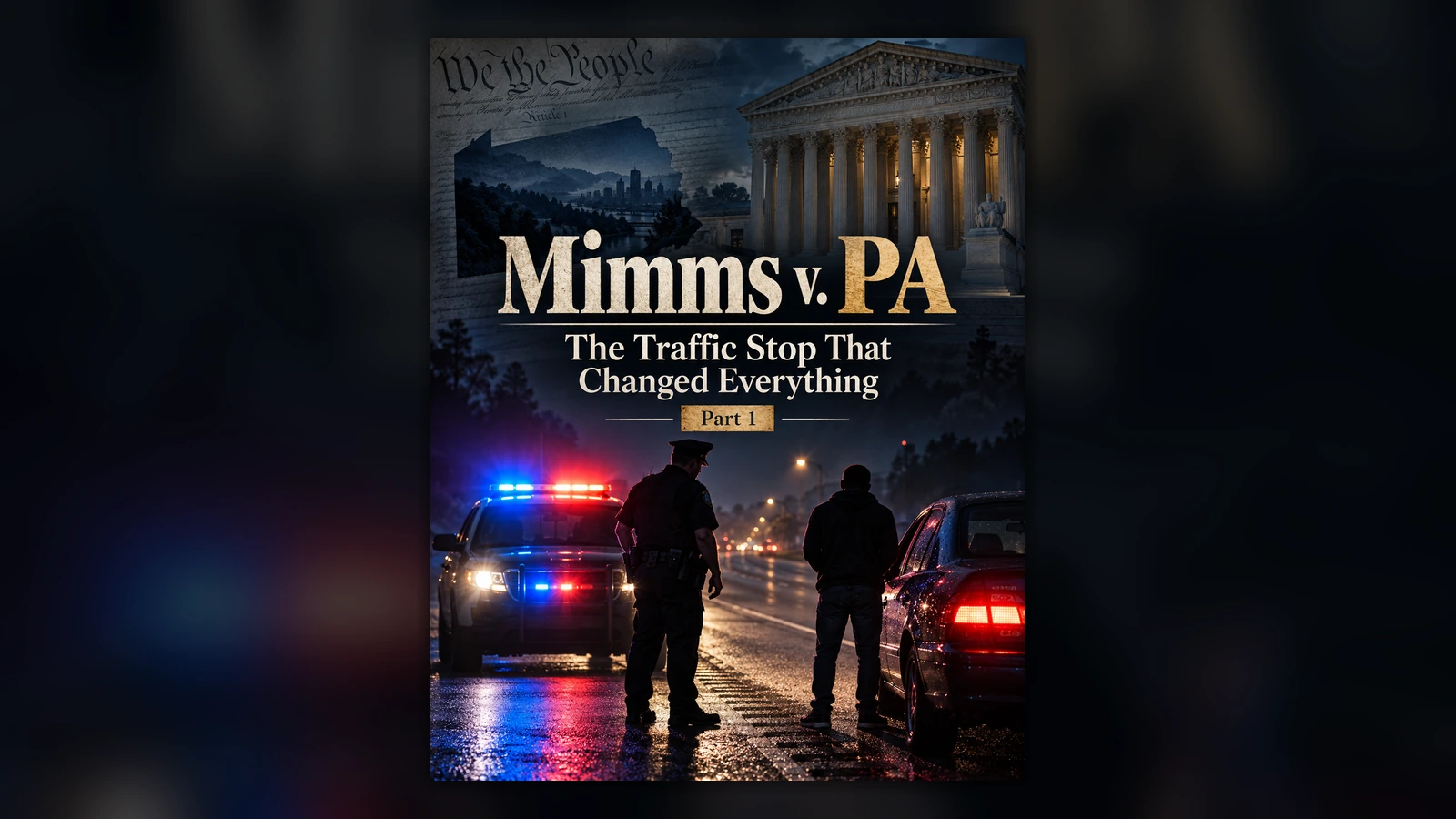
A routine traffic stop in Philadelphia more than half a century ago would ultimately give police officers across the United States an authority they continue to exercise today.
There was no high-speed chase.
There was no report of a violent crime.
There was no suspicious vehicle matching the description of a wanted suspect.
The original reason for the stop was remarkably ordinary:
An expired license plate.
But what happened after Philadelphia police stopped Harry Mimms eventually reached the United States Supreme Court and resulted in one of the most consequential rules governing traffic stops in America.
Today, Pennsylvania v. Mimms, 434 U.S. 106 (1977), stands for a straightforward proposition: once police lawfully stop a vehicle for a traffic violation, an officer may generally order the driver out of the vehicle without first establishing individualized suspicion that the driver is armed, dangerous, or involved in some additional criminal activity.
That rule is now familiar to police officers, defense attorneys and judges.
Its origin is considerably less familiar.
And the history of the case reveals an important distinction that is sometimes lost in discussions about Mimms: the Supreme Court did not rule that a lawful traffic stop automatically authorizes police to frisk a driver.
It authorized something much more specific.
It authorized the exit order.
Understanding how that happened is essential to understanding what came afterward.
It Started in Philadelphia
The case began on September 7, 1970.
Harry Mimms was driving in Philadelphia when two police officers on routine patrol observed that his vehicle displayed an expired license plate.
They stopped him for the purpose of issuing a traffic summons.
What happened next eventually became the constitutional issue at the center of the case.
One of the officers, identified in Pennsylvania court records as Officer Kurtz, approached Mimms and ordered him to step out of the vehicle.
That command was not prompted by something Mimms had done after being stopped.
According to the Pennsylvania Supreme Court's account of the officer's testimony, there was nothing unusual or suspicious about the behavior of Mimms or his passenger before the exit order was given.
The officer did not see the bulge that eventually led to the discovery of a gun until after Mimms was outside the vehicle.
Instead, Officer Kurtz testified that ordering drivers out was simply his practice whenever he conducted a traffic stop.
That fact would become extremely important.
After Mimms exited the vehicle, Kurtz observed a large bulge underneath Mimms's sports jacket.
Concerned that the bulge could be a weapon, the officer conducted a pat-down of Mimms's outer clothing.
He discovered a loaded .38-caliber revolver and ammunition.
Mimms was subsequently charged and convicted of firearms offenses.
But the constitutional fight was only beginning.
Pennsylvania Initially Sided With Mimms
The case traveled through Pennsylvania's appellate courts.
In 1975, the Pennsylvania Superior Court upheld Mimms's conviction.
The Pennsylvania Supreme Court then took the case.
And on February 28, 1977, Pennsylvania's highest court reached a very different conclusion.
The court focused on the moment before the gun was visible.
The question was not simply whether the officer could frisk Mimms after seeing a suspicious bulge. The court instead examined whether police had constitutional authority to order Mimms out of the vehicle in the first place.
That distinction mattered.
Once the bulge became visible, the officer had a specific fact suggesting that Mimms might be armed.
Before Mimms exited, however, the officer had no comparable individualized concern.
Pennsylvania's Supreme Court emphasized that distinction and concluded that an across-the-board practice of ordering drivers from their vehicles could not be justified without objective circumstances supporting the additional intrusion.
The court noted that Officer Kurtz could identify no unusual or suspicious conduct by Mimms or his passenger before issuing the order.
Rather, the officer followed a general practice of ordering drivers out during traffic stops.
The Pennsylvania court described such an indiscriminate procedure as incompatible with the Fourth Amendment and ordered a new trial.
Had that decision remained intact, the constitutional rule governing American traffic stops could look considerably different today.
But Pennsylvania appealed.
The U.S. Supreme Court Takes the Case
The Commonwealth asked the United States Supreme Court to review the Pennsylvania decision.
The Supreme Court agreed.
On December 5, 1977, the Court issued its decision in Pennsylvania v. Mimms, 434 U.S. 106.
The Court reversed Pennsylvania.
Its analysis centered on balancing two competing interests:
the driver's personal liberty and the officer's safety.
Because Mimms had already been lawfully stopped for a traffic violation, the Supreme Court considered the additional requirement that he stand outside his vehicle to be relatively minor.
The Court characterized it as, at most, a “mere inconvenience.”
Officer safety, by contrast, was viewed as a substantial governmental interest.
The result produced the rule that survives today:
Once a vehicle has been lawfully detained for a traffic violation, police may order the driver out without violating the Fourth Amendment merely because the officer lacks a particularized reason to believe that driver is dangerous.
But there is an important limitation.
Mimms Did Not Authorize Automatic Frisks
The exit order and the frisk were two separate constitutional events.
That distinction is critical.
The Supreme Court first decided that ordering Mimms out of the vehicle was permissible.
It then separately examined whether the officer could frisk him.
For the frisk, the Court relied upon Terry v. Ohio, the landmark 1968 decision permitting a limited weapons pat-down when an officer reasonably believes a person may be armed and dangerous.
In Mimms's case, that additional justification was the visible bulge underneath his jacket.
The Supreme Court concluded that the bulge provided sufficient reason for the officer to believe Mimms could be armed and therefore justified the limited weapons search.
That difference remains important:
A lawful traffic stop can permit an exit order without individualized suspicion.
A frisk still requires additional justification.
Later Pennsylvania courts have expressly emphasized this distinction when interpreting Mimms.
Understanding that difference will become particularly important later in this series when we examine how exit orders interact with questioning, frisks, consent searches and broader criminal investigations during modern traffic stops.
The Dissent Saw a Much Bigger Issue
Not every justice agreed with the majority.
Justice John Paul Stevens wrote a dissent joined by Justices William Brennan and Thurgood Marshall.
The disagreement went beyond whether stepping outside a vehicle was inconvenient.
Stevens questioned what would happen when police authority no longer depended on individualized justification.
His concern was discretion.
Traffic stops involve an enormous variety of circumstances, Stevens argued. A family traveling on a Sunday afternoon is not necessarily situated like someone stopped after a high-speed pursuit.
Yet the majority's rule treated the officer's authority to issue the exit command largely the same once the underlying traffic detention was lawful.
More significantly, Stevens warned about the consequences of allowing officers to exercise that authority without explaining why they had chosen to use it against a particular motorist.
He raised the possibility that some drivers could be ordered out while others were left inside based upon arbitrary characteristics — expressly referencing differences including vehicles, bumper stickers and skin color.
The dissent was not claiming that Officer Kurtz had necessarily made his decision based on those characteristics.
Its concern was structural.
If an officer does not need to articulate a reason for exercising a police power against one driver rather than another, how does a court later determine whether that discretion was exercised fairly?
That question would outlive Harry Mimms's traffic stop.
One Small Command, One Enormous Rule
The Supreme Court was careful about the scope of its decision.
The Court did not say that police can order someone from a vehicle whenever an officer simply wants to speak with a driver.
Its holding applied after a vehicle had first been lawfully detained for a traffic violation.
But within that setting, the decision was significant.
Before the officer saw Mimms standing outside his car, there was no visible bulge.
Before the bulge, there was no specific reason to frisk him.
The exit order created the circumstances in which the officer observed the fact that then justified the frisk.
And that sequence raises an issue that has followed Mimms ever since:
How much constitutional significance should attach to an order the Supreme Court considered only a minimal additional intrusion when that order can expose observations that fundamentally change the direction of an encounter?
In Mimms's case:
Expired plate.
Traffic stop.
Exit order.
Visible bulge.
Frisk.
Gun.
Arrest.
Criminal prosecution.
A seemingly small exercise of police authority sat directly in the middle of that chain.
Pennsylvania Created the Case — But Lost the Constitutional Argument
There is an unusual historical irony to Pennsylvania v. Mimms.
The precedent bears Pennsylvania's name because it was the Commonwealth that asked the United States Supreme Court to overturn the ruling of Pennsylvania's own highest court.
The Pennsylvania Supreme Court had concluded that police needed something more than routine practice before ordering a motorist from a vehicle.
The United States Supreme Court decided otherwise.
The federal ruling then became Fourth Amendment precedent throughout the country.
Nearly five decades later, an officer conducting a lawful traffic stop thousands of miles from Philadelphia can exercise authority derived directly from what happened during that Pennsylvania traffic stop.
That makes Mimms more than an old court case.
It is still part of everyday policing.
The Question That Came Next
The Supreme Court's 1977 decision answered one question:
May police order the driver of a lawfully stopped vehicle to exit without individualized suspicion?
The Court said yes.
But court decisions do not operate in laboratories.
They become policies.
They become training.
They become police practices.
And police officers eventually discover ways that legal authority can be incorporated into investigative techniques that the judges deciding the original case may never have specifically contemplated.
That brings us to the next question in this series.
The Supreme Court justified Mimms primarily through officer safety and described the additional intrusion on the driver as minimal.
Nearly 50 years later:
Is that still how the authority is primarily being used?
Or has the Mimms exit order evolved into something more?
In Part 2, RTK Media will examine how Mimms operates during modern traffic stops — including its relationship to questioning, frisks, consent searches, criminal interdiction and the discretion officers exercise over which motorists are ordered from their vehicles.
Because before deciding whether a nearly 50-year-old rule needs reform, there is a more fundamental question to answer:
What are police actually doing with it?
About This Series
This is Part 1 of an RTK Media examination of Pennsylvania v. Mimms and its continuing effect on traffic stops.
Part 1 — The History: How an expired Pennsylvania license plate produced a nationwide Fourth Amendment rule.
Part 2 — The Practice: How police use Mimms authority today and whether modern applications remain tied to its original officer-safety rationale.
Part 3 — The Future: Current safeguards, competing perspectives and policy options that could preserve legitimate officer-safety interests while addressing concerns about discretion and accountability.
Don’t Speculate. Document.