
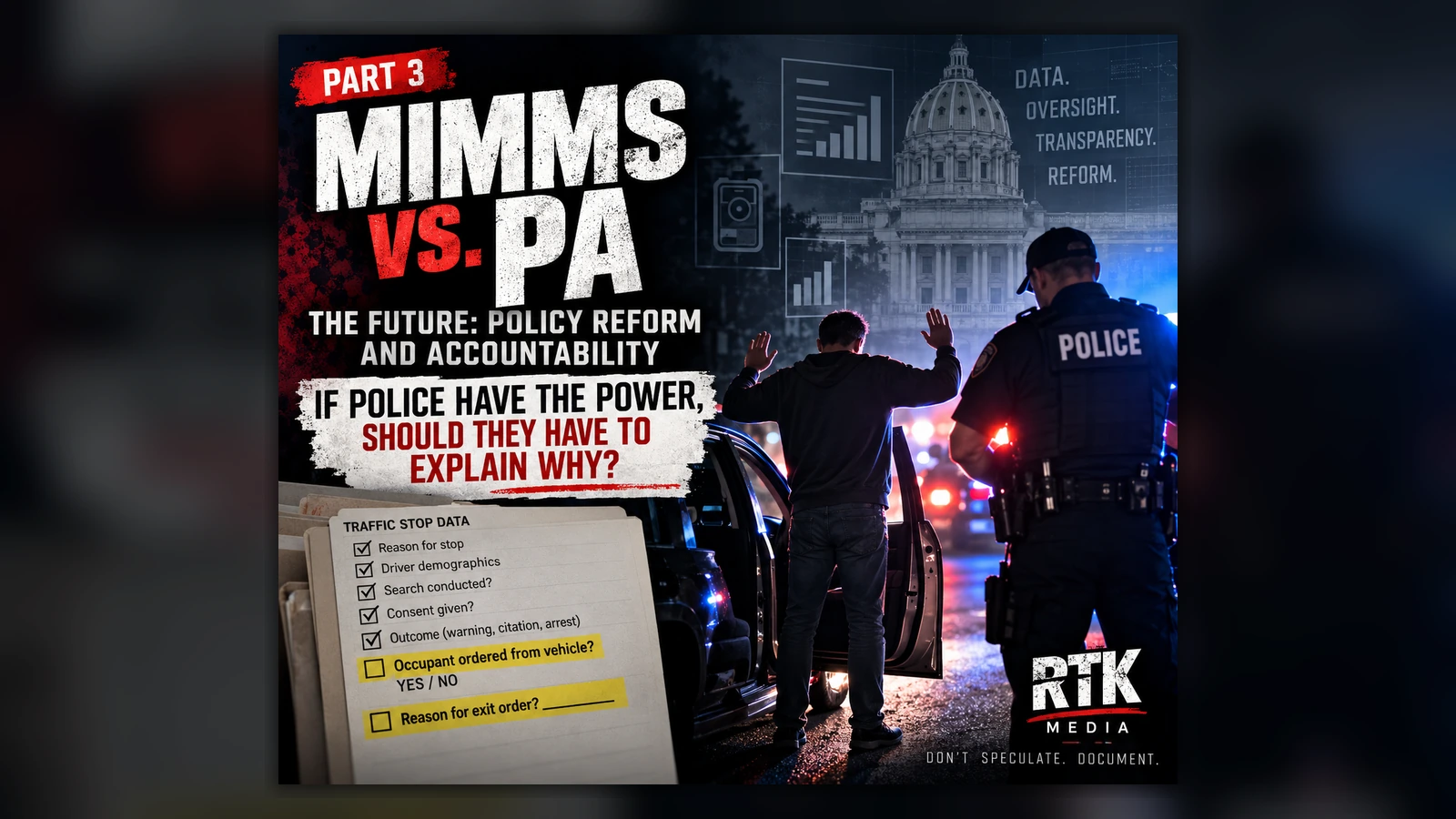
For nearly 50 years, Pennsylvania v. Mimms has given police officers extraordinarily broad authority during traffic stops.
If the stop itself is lawful, an officer may generally order the driver out of the vehicle without first proving that the driver is dangerous.
Twenty years later, the United States Supreme Court extended similar authority to passengers in Maryland v. Wilson.
The rule was created primarily in the name of officer safety.
But Parts 1 and 2 of this series raised a much more difficult question:
What happens when government gives an officer substantial authority but requires almost no individualized explanation for why that authority was exercised against a particular person?
That question becomes even more important today.
Traffic stops are increasingly captured by body cameras.
Pennsylvania is collecting more information about who gets stopped, why they get stopped, whether they are searched, and what happens afterward.
Departments can analyze police activity with tools that did not exist when Harry Mimms was pulled over in Philadelphia in 1970.
So perhaps the question facing Pennsylvania is no longer simply whether officers should possess Mimms authority.
The United States Supreme Court answered that question decades ago.
Perhaps the better question is:
If police have the power, should they have to explain when and why they use it?
The Problem Is Not Officer Safety
Any serious discussion of Mimms has to begin by recognizing something obvious:
Traffic stops can be dangerous.
Police officers routinely approach vehicles containing people they do not know, often at night, alongside moving traffic, without knowing whether weapons are present.
The Supreme Court relied heavily on that concern in Mimms.
It noted both the potential danger posed by occupants and the danger to officers standing beside moving traffic.
The Court therefore concluded that requiring an already lawfully stopped driver to stand outside the vehicle was only a minimal additional intrusion when weighed against legitimate officer safety interests.
That reasoning cannot simply be dismissed.
There are circumstances where removing someone from a vehicle may unquestionably make an encounter safer.
But acknowledging that fact does not answer a different question:
Should every exercise of that authority be effectively invisible in the data?
That is where reform should begin.
Pennsylvania Already Tracks Traffic Stops
Pennsylvania has recently taken a significant step toward increased transparency in traffic enforcement.
Under 75 Pa.C.S. §6329, Pennsylvania State Police officers and local police officers must collect information during self-initiated traffic stops.
Among the required information:
The reason for the traffic stop.
The perceived race and ethnicity of the driver.
The driver's gender and age.
Whether a search of the driver, passenger or vehicle occurred.
Whether consent was involved.
The result of the search.
Whether the encounter resulted in a warning, citation, arrest or other action.
These requirements grew out of legislation associated with Pennsylvania's Paul Miller's Law, which also expanded statewide traffic stop data collection and public reporting.
The Pennsylvania State Police had already been conducting extensive traffic stop data analysis voluntarily.
Its Contact Data Reporting program examines demographic information, enforcement outcomes, searches and other aspects of trooper initiated stops. PSP describes the program as a tool for identifying disparities, improving policy and training, and strengthening public trust.
But there is a striking omission.
The statute specifically tracks whether someone was searched.
It tracks whether a driver was arrested.
It tracks citations.
It tracks warnings.
It tracks demographics.
Yet the statute does not specifically require officers to report one of the most consequential discretionary events that can occur during a traffic stop:
Was the driver or passenger ordered out of the vehicle?
That could be changed.
Reform No. 1: Record Every Exit Order
The simplest reform may also be the most powerful.
Add one field to the statewide traffic stop record:
Occupant ordered from vehicle? YES / NO
If yes:
Reason for exit order.
Possible standardized categories could include:
Specific officer safety concern.
Observed suspicious movement.
Suspected weapon.
Driver arrest.
Vehicle search.
DUI investigation.
Medical or emergency concern.
Roadside safety.
Routine departmental practice.
Investigative purpose.
Other, with an explanation.
Nothing about that requirement would necessarily prevent an officer from exercising Mimms authority.
It would simply create a record that the authority was exercised.
That distinction matters.
A police officer might still constitutionally possess broad discretion.
But documented discretion can be reviewed.
Undocumented discretion largely cannot.
Reform No. 2: Require an Articulated Reason Even If the Constitution Does Not
The Fourth Amendment establishes a constitutional floor.
It does not necessarily dictate every police department's internal policy.
A police department can impose rules on its officers that are more restrictive than what the Constitution minimally allows.
Pennsylvania or individual departments could therefore adopt a straightforward policy:
An officer ordering an occupant from a vehicle should document the reason for doing so.
Importantly, that does not necessarily mean the officer must establish reasonable suspicion of danger before every exit order.
That would present a much larger legal and policy question.
The more modest reform is simply:
Use the authority if necessary, but explain afterward why you used it.
That requirement would address one of the central concerns raised throughout this series.
Why this driver?
Why this passenger?
Why at this point in the encounter?
Why after the driver questioned the stop?
Why after consent to search was refused?
Why immediately upon contact?
Those answers could then become reviewable information rather than speculation.
Reform No. 3: Track Officers Who Use Mimms Frequently
Once exit orders are documented, patterns become measurable.
Consider two officers assigned to similar traffic enforcement duties.
Officer A orders occupants out during 4% of stops.
Officer B does so during 38%.
That difference would not prove misconduct.
There could be legitimate reasons.
Maybe Officer B conducts substantially more DUI enforcement.
Maybe the officer works a specialized criminal interdiction assignment.
Maybe the stops occur in different circumstances.
But the disparity would create something extremely valuable:
A question worth reviewing.
Departments already use data to examine enforcement activity.
PSP's existing traffic stop program analyzes patterns by troop and other categories, and commanders use data to examine trends and potential data quality issues.
Exit orders could be treated similarly.
Departments could examine:
Exit order rate by officer.
Exit order rate by unit.
Exit order rate by reason for stop.
Exit order rate by driver demographics.
Percentage followed by frisk.
Percentage followed by consent search request.
Percentage followed by vehicle search.
Percentage resulting in contraband.
Percentage resulting only in the original traffic warning or citation.
Again, none of those numbers alone establishes wrongdoing.
But they can expose patterns worthy of review.
That is what meaningful oversight looks like.
Reform No. 4: Compare the Report to the Body Camera
Traffic stop documentation becomes considerably more valuable when paired with body camera footage.
Suppose an officer records:
Reason for removal: officer safety.
Body camera footage might show exactly why.
Perhaps the driver repeatedly reached under the seat.
Perhaps the officer observed a weapon.
Perhaps occupants were moving around the vehicle.
The video could strongly validate the officer's explanation.
But body cameras could reveal something else.
The driver questions the ticket.
The conversation becomes argumentative.
The driver refuses permission to search.
The officer immediately orders everyone out.
Again, that sequence does not automatically prove retaliation or unconstitutional conduct.
Mimms may still authorize the exit order.
But supervisors could ask a legitimate policy question:
Was the authority exercised for the purpose the department intends?
Random body camera audits could answer that far better than constitutional litigation years afterward.
Reform No. 5: Clearly Separate Exit Orders From Searches
One of the recurring problems surrounding Mimms is that several different police powers can occur in rapid succession.
A motorist may experience them as one continuous encounter:
Stop.
Exit order.
Frisk.
Questioning.
Consent request.
Vehicle search.
But constitutionally, those actions do not all rest on the same authority.
Mimms permits the exit order during a lawful traffic detention.
It does not itself create an automatic right to frisk the person.
In the original case, the Supreme Court specifically noted that Pennsylvania was not claiming officers could automatically frisk every occupant merely because a traffic stop occurred. The frisk of Harry Mimms was justified separately after the officer saw a bulge suggesting a weapon.
Similarly, Mimms does not automatically authorize a vehicle search.
Those distinctions should be reinforced in policy and training.
An officer should be able to answer separately:
Why was the person ordered out?
Why was the person frisked?
Why was the vehicle searched?
Those are separate exercises of governmental authority.
They should remain separate on paper as well.
Reform No. 6: Protect the Right to Say No
There is another area where policy could provide clarity.
Drivers have the right to refuse a voluntary request for consent to search.
Drivers may also question officers, ask why they were stopped, and request supervisors, provided their conduct does not independently violate the law or obstruct legitimate police activity.
Departments could make explicit in policy that the exercise of a constitutional right, standing alone, should not be treated as evidence of dangerousness.
A refusal to consent to a voluntary search should not automatically become the reason for escalating an encounter.
A driver calmly questioning the basis of a stop should not, standing alone, become evidence that the person presents a physical danger.
An irritated tone should not automatically equal a safety threat.
Police may still respond when behavior actually becomes threatening or circumstances create genuine safety concerns.
The point is simply to distinguish:
Disagreement
from
Danger.
That distinction protects motorists while also strengthening legitimate officer safety decisions.
There Is Already a Limit on Turning Traffic Stops Into Criminal Investigations
Mimms does not give police unlimited time.
The Supreme Court made that clear in Rodriguez v. United States.
In that case, police completed the ordinary tasks associated with a traffic stop but continued detaining the driver so that a police dog could sniff the vehicle.
The delay lasted only several additional minutes.
The Supreme Court nevertheless held that, absent independent reasonable suspicion, extending a traffic stop beyond the time reasonably necessary to address the traffic violation violates the Fourth Amendment.
That ruling establishes an important principle.
Police authority during traffic stops is not unlimited merely because the original seizure was lawful.
The stop has a mission.
Ordinary tasks include things such as checking a license, registration, warrants and addressing the traffic offense.
Police may conduct unrelated inquiries that do not prolong the stop, but they generally cannot add time for unrelated criminal investigation without additional justification.
That same concept provides a useful framework for thinking about Mimms.
Police authority can exist while still being subject to boundaries, documentation and review.
Could Pennsylvania Provide Greater Protection?
There is another avenue worth discussing carefully.
The Pennsylvania Constitution contains its own search and seizure provision: Article I, Section 8.
Pennsylvania courts do not always interpret that provision identically to the Fourth Amendment.
The Pennsylvania Supreme Court has recognized circumstances in which Article I, Section 8 provides protections that differ from federal seizure doctrine.
That does not mean Pennsylvania courts have invalidated Mimms under Article I, Section 8.
They have not.
Pennsylvania appellate cases have continued to recognize the basic Mimms rule.
So this is not an area where RTK Media should declare that Pennsylvania's Constitution already prohibits Mimms orders.
Current Pennsylvania law does not support that conclusion.
But Article I, Section 8 remains relevant to the broader legal debate over how much protection Pennsylvania chooses to give its citizens beyond federal minimums.
Reform Does Not Have to Mean Prohibiting Mimms
That may be the most important point of this entire discussion.
The debate does not need to be:
Keep Mimms exactly as it is
versus
Prevent police from ever ordering drivers out.
There is enormous territory between those positions.
Pennsylvania could leave the constitutional authority completely intact while requiring:
Documentation.
Data collection.
Supervisory review.
Body camera auditing.
Clear separation between exit orders, frisks and searches.
Training distinguishing disagreement from genuine threats.
Public reporting of aggregate exit order data.
None of those reforms would necessarily prevent an officer facing an actual danger from immediately ordering someone from a vehicle.
Officer safety would remain protected.
What would change is accountability afterward.
And Pennsylvania Already Has the Infrastructure
This may be the strongest argument that reform is realistic rather than theoretical.
Pennsylvania already requires traffic stop data collection.
The state already records why vehicles are stopped.
It already records driver demographics.
It already records searches.
It already records consent.
It already records outcomes.
PSP already performs detailed analysis of hundreds of thousands of traffic stops and publicly releases its findings.
Adding an exit order field would therefore not require inventing an entirely new accountability system.
The infrastructure largely exists.
The state simply does not currently require that particular piece of information.
And without it, one of the broadest discretionary powers officers possess during traffic stops remains difficult to measure.
What Would the Data Tell Us?
Perhaps it would show that Mimms orders are relatively rare.
Perhaps they are overwhelmingly connected to genuine safety concerns.
Perhaps some departments use them routinely while others almost never do.
Perhaps certain officers issue them far more often than their peers.
Perhaps particular traffic offenses are disproportionately associated with occupant removal.
Perhaps exit orders frequently precede consent searches.
Perhaps none of those concerns are supported by the evidence.
That is precisely why the data should exist.
Public policy should not depend entirely upon assumptions from either side.
Police should not automatically be presumed to be abusing the authority.
Motorists should not simply be told that abuse is impossible because the authority is constitutional.
Measure it.
Then decide.
That is the difference between speculation and oversight.
Fifty Years Later, Ask “Why?”
When the Supreme Court decided Pennsylvania v. Mimms in 1977, it viewed the requirement that a driver step outside the vehicle as an extremely small additional intrusion.
The Court weighed that intrusion against officer safety and decided the balance favored police.
Nearly half a century later, the basic constitutional rule remains.
But policing has changed dramatically.
Body cameras can document encounters.
Computerized records can identify patterns.
Statewide databases can compare officers, departments, outcomes and demographics.
Pennsylvania now collects traffic stop information on a scale that would have been unimaginable when Harry Mimms was stopped.
So perhaps Pennsylvania does not need to begin by asking whether police should lose the authority created by Mimms.
Perhaps it should begin with something much simpler.
When an officer tells a Pennsylvania motorist:
“Step out of the vehicle.”
The driver may still be legally required to comply.
But government should be capable of answering another question afterward:
Why?
Not because every explanation will expose misconduct.
Quite the opposite.
Documentation would also protect officers who exercise the authority for legitimate reasons.
A recorded safety concern backed by body camera footage provides strong evidence supporting the officer's decision.
Accountability works both ways.
Good police decisions become easier to defend.
Questionable patterns become easier to identify.
And constitutional authority becomes easier for the public to trust.
That is why the future of Pennsylvania v. Mimms does not necessarily require eliminating the power the Supreme Court created.
It may simply require bringing a 1977 rule into a world where government has the ability, and perhaps the responsibility, to document how that power is actually used.
The question for Pennsylvania is no longer just:
“Can police do this?”
The Supreme Court answered that almost 50 years ago.
The better question may be:
“If police can do it, why shouldn't they have to tell us why?”
The RTK Media Mimms Series
Part 1: The History How an expired Pennsylvania license plate created a nationwide Fourth Amendment rule.
Part 2: The Practice How an officer safety rule can give police broad discretionary control during modern traffic stops.
Part 3: The Future How documentation, statewide data collection, body camera review and policy reform could add accountability without eliminating legitimate officer safety authority.
Don’t Speculate. Document.